
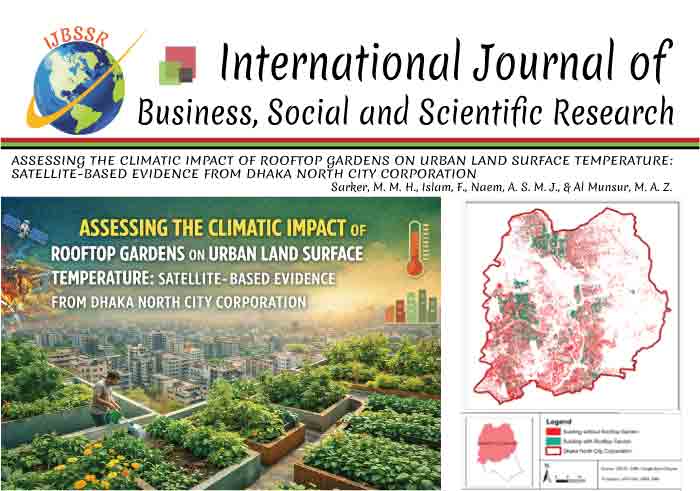
ASSESSING THE CLIMATIC IMPACT OF ROOFTOP GARDENS ON URBAN LAND SURFACE TEMPERATURE: SATELLITE-BASED EVIDENCE FROM DHAKA NORTH CITY CORPORATION
Author Name:
Md. Motaleb Hossain Sarker, Ferzana Islam, A.S.M Julker Naem and Md. Abu Zafur AL Munsur
Research Area: Agricultural Science
Volume: 14
Issue: 01
Page No: 20–27
Emailed: 0
Total Downloads: 589
Country:
PDF View:
Research Area: Agricultural Science
Volume: 14
Issue: 01
Page No: 20–27
Emailed: 0
Total Downloads: 589
Country:
PDF View:
DOI: http://doi.org/10.55706/ijbssr14104
URL: http://www.ijbssr.com/10.55706/ijbssr14104
Rapid urbanization and the widespread expansion of impervious surfaces
have intensified urban heat stress in tropical megacities, amplifying the Urban
Heat Island (UHI) effect and associated environmental and public health risks.
Dhaka, Bangladesh, is particularly vulnerable due to its high population
density, limited green space, and pronounced pre-monsoon heat extremes. Rooftop
gardens have been proposed as a nature-based solution for urban heat
mitigation; however, empirical, building-scale evidence from dense tropical
cities remains limited. This study evaluates the cooling effects of rooftop
gardens on rooftop land surface temperature (LST) in Dhaka North City
Corporation (DNCC) using satellite-based observations. Building footprints were
obtained from the Google Open Buildings dataset and validated using
high-resolution imagery. Rooftop gardens were identified through a combined
manual and remote sensing approach, classifying 2,012 buildings with rooftop
gardens and 43,553 buildings without. Daytime LST was derived for the
pre-monsoon period (March–May) of 2022 using Landsat 8 Collection 2 Level-2
data processed in Google Earth Engine. Statistical analyses were conducted to
compare mean temperatures, thermal variability, and extreme temperature conditions
between the two building categories. The results show that rooftop gardens
reduce mean rooftop LST by up to 1.99 °C during peak heat in May and suppress
extreme rooftop temperatures by 3.9–6.4 °C across the pre-monsoon season.
Vegetated rooftops also exhibit reduced thermal variability and fewer extreme
temperature occurrences. These findings demonstrate that rooftop gardens offer
significant thermal benefits under extreme climatic conditions and represent a
scalable, low-cost nature-based strategy for mitigating urban heat stress in
rapidly urbanizing tropical cities.